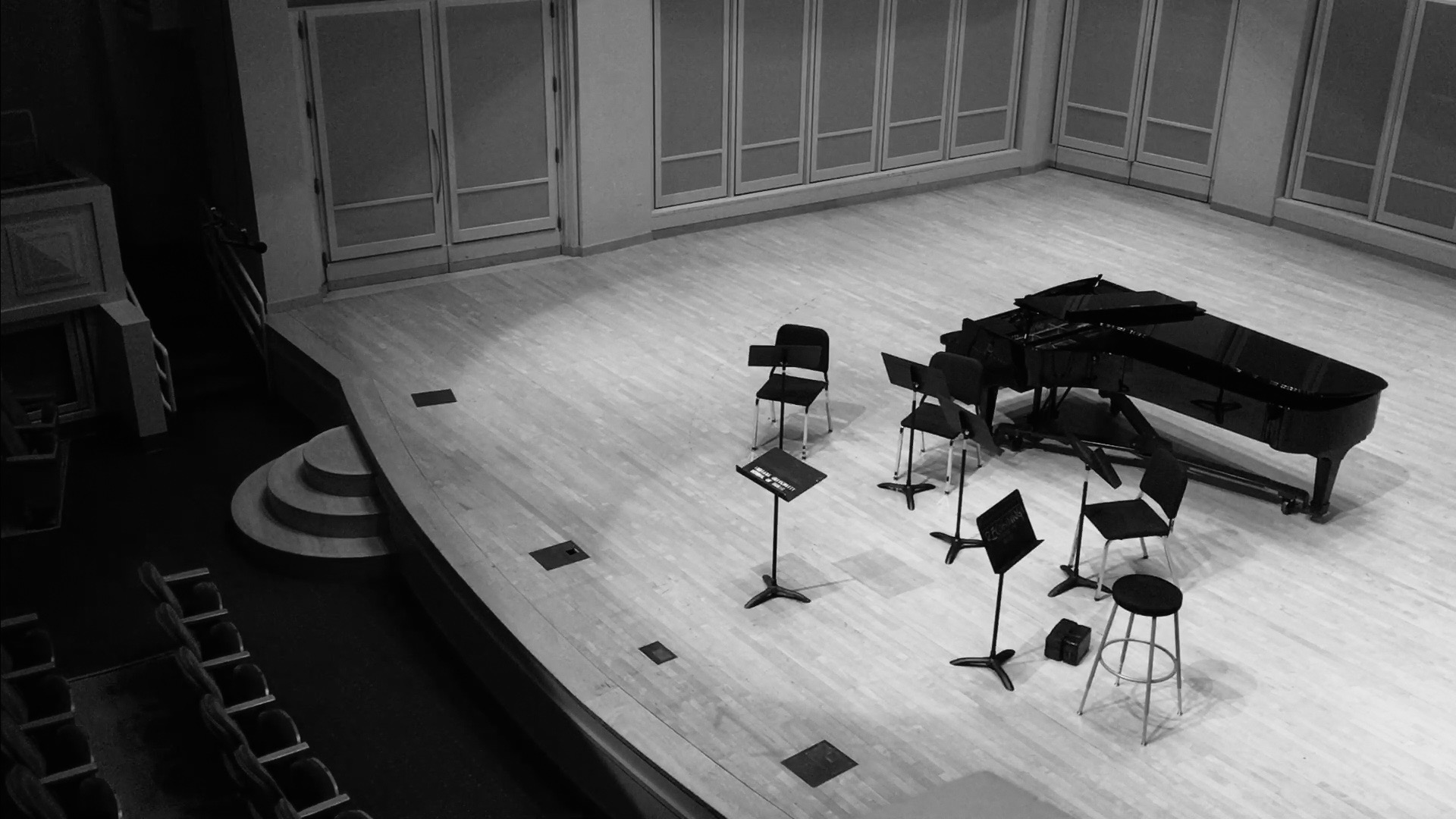
Yi-De Chen’s D.M. Composition Recital
Oct. 21, 8:00 pm ~ 9:00 pm, 2021 (Thurs.)
Location: Auer Hall
(located on the 2nd floor of the Simon Music Center)
Address:
200 South Jordan Ave, Bloomington, IN 47405

Info: This is a free, public concert by
Jacobs School of Music, Indiana University Bloomington
Program
1. The Deep Ocean for Solo Piano and Live Electronics (2021) [7’00”]
Yuseok Seol (In Korean: 설유석), piano, live electronics
This piece is written for piano and live electronics. The electronics part involves sixteen pre-recorded piano fragments, live-processed in Max. While playing, the pianist presses the MIDI sustain-pedal to trigger the fixed media.
To elaborate on my image of the deep ocean, I use thick chords to make the piano part more resonant and allow the electronic music part to expand. On the other hand, the transformed fixed media may sustain a relatively long time to support and blend with piano sounds. The piece starts from a motive in the low register and gradually grows into significant passages. In texture and musical emotion, the electronic and piano parts complement and blend with each other.
2. Silent Maples for Clarinet, Horn, Bassoon, Violin, Viola, Violoncello, and Contrabass (2019) [9’00”]
Adrienne Ward, clarinet
Lauren Hallonquist, bassoon
Douglas Nunes, horn
Evan Pasternak, violin
Alice Ford, viola
Scott Sgueglia, violoncello
Will Kline, contrabass
Andrew Downs, conductor
In late October, many kinds of trees start to lose their leaves. Leaves of yellow, red, and green build up the dramatic scenery of the village where I live. Getting close to any of those trees, I can perceive the delicate organization of the leaves, branches, trunks, and roots, which structure the beauty of the trees. Of those trees, the maples standing by my house are the most beautiful during the transition between the seasons. Because they made such an impression on me, I wrote a chamber piece to express my feelings and emotions.
The instrumentation of clarinet, bassoon, horn, and strings provide the possibilities of timbres and characteristics that I need. For instance, delicate sounds made by col legno battuto can be regarded as falling leaves; soft harmonic tremolos can be considered as breeze sounds.
3. Do Question Marks Work Differently? for Saxophone Quartet (2020) [7’30”]
Josh Tzuo, soprano saxophone
Kacie Brown, alto saxophone
Josh Flores, tenor saxophone
Chung Him Chu, baritone saxophone
Question marks can change the sense of a sentence when applied to various sentence structures. In this piece, I use glissandos, upward scales, or musical passages with increasing dynamics to represent the meanings of question marks.
It is also interesting to represent various types of questions. For instance, when a question is unanswered, people may respond to it directly by asking the same question again, asking the same question another way, or even making their answers in their minds. These phenomena are musically represented in this work.
4. Moments of Mystery for Flute (doubling Alto Flute), Percussion, Harp, Guitar, and Violoncello (2021) [8’00”]
Jamey Guzman, flute (doubling alto flute)
Eric Zielsdorf, percussion
Fangfang Liu, guitar
Julia Johnson, harp
Thea Dardanis, violoncello
Robert Rankin, conductor
I wanted to express an imaginative, mysterious atmosphere based on the unpredictable changes of texture, dramatic emotions, and attractive timbres in this piece. The delicate sounds are made and blended to create a unique entity.
After a short introduction, fascinating harmonies dominate the music and gradually grow into a larger structure. The aggregation of energy leads to the climax with colorful timbres and harmonies. Finally, the fragmentations, such as gestures made by whistle tones, scraping sounds, and glissandos, are covered and stopped by a giant crescendo from the tam-tam.
5. Variable Motion for Flute, Violin, Violoncello, and Piano (2019) [9’00”]
Graeme Sugden, flute
Eli Willis, violin
Zephaniah Pearlstein, violoncello
Yuseok Seol (In Korean: 설유석), piano
Joshua Catanzaro, conductor
Placing different rhythms in a musical passage can bring about various pulses and patterns. My deep love for rhythmic materials made writing a piece with dramatic and fast-paced rhythmic changes an exciting challenge.
The work consists of three movements, each of which has distinctive characteristics; the first movement is in a fast tempo; it is full of momentum, owing primarily to its jazz references. The second movement is even faster; the second movement is humorous, with rapid alterations of dynamics and textures. The last movement is relatively slow; it recalls some materials from the first movement but transforms them into different atmospheres to sound lyrical and energetic.
6. Prelude to Eudaimonia for Solo Organ (2021) [7’30”]
Elijah Buerk, organ
Eudaimonia is a Greek term elaborated by Aristotle, which can be translated as happiness or welfare. In this organ piece, I transformed the concept of Eudaimonia into a music context. I believe the process of composing can achieve this by allowing one to express inner thoughts and emotions, and in so doing, tap into their spiritual life.
In 2011, I had a chance to learn about the organ, and in 2013, I took an introductory organ course for one semester. I felt the organ was a fascinating instrument. With the essential cultivation, I also wrote down some fragments. This year, I completed this piece based on the fragments written ten years ago. In this piece, I hope to express that I am still doing well, satisfied with my life, and, most importantly, closer to God.
___________________________________
Special Thankfulness to
Champagne Location Recording
Audio and Video Recording
by
Matthew Champagne

Welcome!
Feel free to Join Us.
 Yi-De Chen, Composer