
Press
Da Capo Voice Chior Concert
Sin Chew Daily
Da Capo Voice Chior Concert
1Notr: Sin Chew Daily is the largest Chinese-language newspaper in Malaysia, published by Asahi Press Sdn. Bhd. The title of the newspaper’s masthead is Sin Chew Daily.
Synesthetic Perceptions:
An Interview with Composer Yi-De Chen
Journal SEAMUS – The Society for Electro-Acoustic Music in the United States, vol. 31, nos. 1-2, pp. 34-37. ISSN 0897-6473.
Date: April 8, 2024
Interviewer: Dr. Drake Andersen

Accessed at the link.
Yi-De Chen is a composer from Taipei, Taiwan who experiences both music and life in a unique way. As Yi-De explains, “I am a composer with retinitis pigmentosa, which adds a unique perspective to my musical expression.” This perspective, along with Yi-De’s experience of synesthesia, has influenced Yi-De’s creative process, as well as his outlook on music, sound, and life more generally.
Curated Collection of Yi-De Chen’s Works
National Education Radio─Taiwan Music DO RE MI
Date: April 9, 2023
Host: Mei-Lien Liu
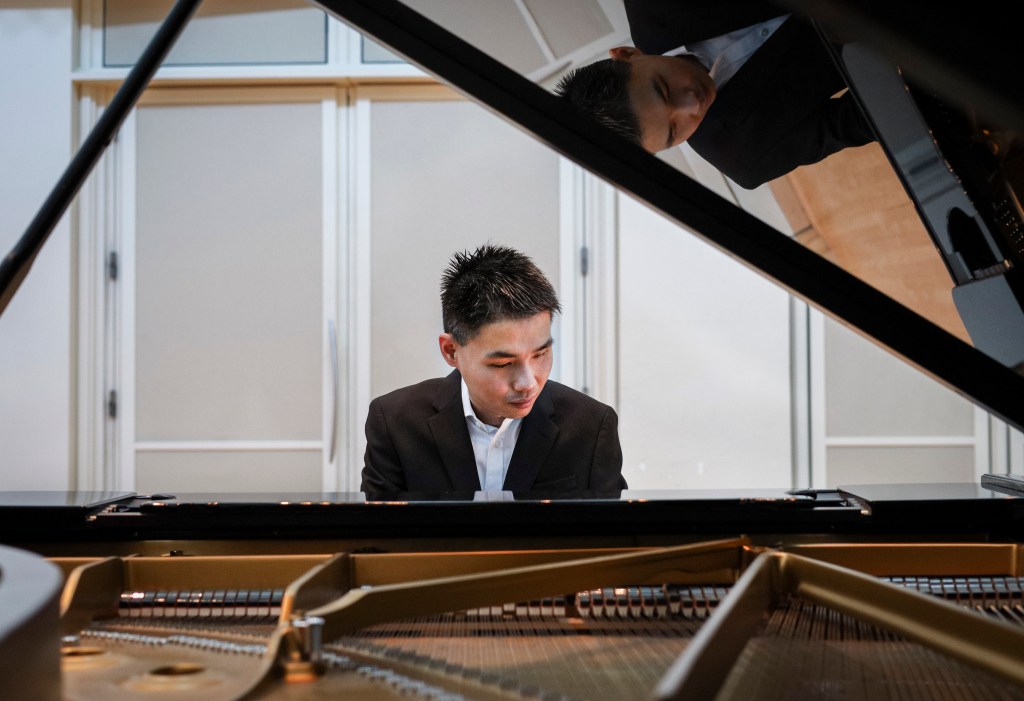
Good day, dear listeners of Taiwan Music DO RE MI!
Encouraging young composers is an annual tradition here in our program. And today, allow me to introduce you to a rising star, Yi-De Chen, hailing from Hualien. After completing his Master’s in Music Composition at Taipei National University of the Arts, he pursued further studies in the United States, earning a doctoral degree.
At Taipei National University of the Arts, he actively collaborated with various performance groups and film production teams. He composed Music for animations, commercials, and movies! Now, let’s hear all about it from our host, Mei-Lien Liu.
Next up, we have the debut performance of the Malaysian choir, Dá Capo Voice Choir, featuring the composition “Three Calls to the Sea” with lyrics by Malaysian Chinese poet Ming-Cheng Hsieh and music by Yi-De Chen. Please enjoy this live recording from a concert in Malaysia on July 31, 2022, conducted by Chee-Chuan Seow, with piano accompaniment by Cheng-Yuan Lin.
Date: 19:30, July 31, 2022
Venue: Bobos Music Studio, Klang, State of Selangor, Malaysia
Yi-De Chen’s (DM ’22) music released by Phasma Music in Poland and performed in Spain
Newsletter by Indiana University Jacobs School of Music Composition Department
Date: November 2022

Chen’s saxophone quartet, Do Question Marks Work Differently? was included in the album “SQ,” released by Phasma Music in Poland this summer.
His string quartet Diffusion was performed by the Mivos Quartet at the Valéncia International Performance Academy and Festival in Spain this July. This piece was performed by the Julius Quartet this February and the Beo String Quartet last July.
Date: 19:00, July 14, 2022
Venue: Ateneo Musical del Puerto, 40 Carrer de Francesc Baldomar, València, Spain
Yi-De Chen’s Works Featured in CNMF 2021 and NYCEMF 2021
Newsletter by Indiana University Jacobs School of Music Composition Department
Date: December 2021

Yi-De Chen’s “Diffusion” for String Quartet (2021), commissioned by the Beo String Quartet, was featured in the Charlotte New Music Festival’s online concert in July 2021. In residence at the festival this year, the brilliant Beo String Quartet started working on this piece two months before the concert, making the performance impressive. Chen was glad to meet many talented, supportive composers, performers, and mentors at this unforgettable conference.
Also, Chen’s “The Changeable Weather” for live electronics (2020) was featured in the New York City Electroacoustic Music Festival 2021. This interactive electronic music work for nanoKONTROL2, Max, and Kyma was video-documented by Chen in November 2020. This video documentation is a live performance that shows his operating the nanoKONTROL2 in Taiwan, with the sound produced in Jacobs School’s CECM Studio in real-time, using the UDP network transmission infrastructure. He appreciates all the support he received from his mentors at Jacobs.
Date: 18:00, July 30, 2021
Venue: Pre-recorded Online Concert
Date: 20:00, June 26, 2022
Venue: The Loreto Theater at the Sheen Center, New York, United States
Yi-De Chen’s Debut Percussion Composition Strikes a Fresh Flavor for Taiwanese Bubble Tea
National Chengchi University “University News” (Issue 154, Arts and Culture Section)
Date: June 13, 2013
Reporter: Jia-Hua Lee / Taipei Report

“Flowers Blooming in the Unknown – Chamber Music Exhibition for Emerging Composers” opened at the Taipei Forum Music’s Music Theater on the evening of the 25th. Each member of the Ten Directions Ensemble simultaneously played six to seven percussion instruments, setting the stage with “The Story of Pearl Milk Tea,” composed by Yi-De Chen, a student from Taipei National University of the Arts.
“The Story of Pearl Milk Tea” is a percussion quartet. It begins with unpitched metallic instruments such as gongs, chimes, cymbals, and xylophones, creating a lingering reverberation in the space after the instrument sounds cease, symbolizing the turbidity at the bottom of bubble tea. Following that, a more distinct rhythm emerges, with the sound of the bowl-shaped percussion instrument “qing” representing the pulsation of pearls. In the middle section, there are more intense changes, with the addition of bright and crisp sounds from the xylophone and high-pitched xylophone, symbolizing the transparency of the grass jelly.
“The Story of Pearl Milk Tea” is Yi-De Chen’s debut percussion composition, which took nearly an entire semester to conceive. Compared to previous orchestral works, composing for percussion instruments, where each note is terse, presented relative difficulties. Chen Yide drew inspiration from everyday life, hoping to bring the audience closer to his creation. He believes that the point-like sounds and unique reverberations of percussion instruments often make him think of the pulsation of pearls.
Performing member and student of the Department of Orchestral and Percussion Instruments at Taipei National University of the Arts, Weng Yinghan, said, “I am responsible for the ‘qing’ part, and the unstable beats it presents represent the pulsating pearls.” Furthermore, she believes that the gradually intensifying and rapid strikes on the chimes in a segment represent the boiling process until the music suddenly stops at the end, symbolizing the cooling of the pearls.
The leader and producer of the Taipei Forum Music Xu Bonian stated that modern and serious music like “The Story of Pearl Milk Tea” conveys the unique vocabulary of the composer and is not as quickly accessible and entertaining to the public as popular music.
Audience member and student from National Chengchi University who has experience with percussion instruments, Luo Yiting, commented, “The performance was vibrant, not only in terms of the variety of instruments, which left me visually overwhelmed, but also in the unique techniques used, such as incorporating seashell wind chimes or using strings to rub against cymbals.”
Date: 19:30, May 25, 2013, premiere
Venue: Forum Music Auditorium, Taipei City, Taiwan
The Two Ends of Sound Art─Composition and Performance
Art Plus Maganize (Issue 27)
Publisher: Art Map
Date: January 2014
Author: Fang-Yi Lin
As the year draws to a close and we enter the busiest performance season, this year stands out from previous ones in the contemporary music scene. Over just one month, many concerts showcasing the works of composers from various generations in Taiwan have taken center stage. From composers like Chen Szu-Shih, Kuo Chih-yuan, Chang Hao, Lai Te-ho, and others participating in the Composer Score Publication Project series organized by the National Center for Traditional Arts under the Ministry of Culture to the emerging young composers currently studying both domestically and abroad, the sheer number of composers contributing to these events is astonishing. Despite Western music’s challenges in Taiwan in recent years due to the rising wave of local cultural awareness, there is still a remarkable influx of young talents dedicated to contemporary composition. On the other hand, the abundance of new works being presented has also spurred the participation of numerous musicians. The contrast between classical repertoire and contemporary compositions is strikingly evident in the performers, highlighting their distinct interpretations and attitudes toward recent creations. This aspect has become integral to these concerts, offering a unique perspective beyond the works themselves.
The first international cultural organization initiated by the private sector in Taiwan is the Asian Composers’ Alliance. The Asian Composers’ Alliance has just concluded its four-member work presentation series, “Music Taiwan,” featuring composers of all ages, including the young generation. Among them, Chen Yide, born in 1988, presented his piece “My Expressions,” which had recently won the National Taiwan Symphony Orchestra Composition Competition. Before the performance, he briefly introduced the piece and personally conducted it to the audience. The shy composer mentioned that a breakup inspired this work. While his conducting skills were still somewhat inexperienced, by the third movement, he became so moved that he stood up. The emotions of a young man, his sorrow and longing, were evident not only in the music but also in the program notes and the composer’s facial expressions during the performance. Sitting in the audience, I couldn’t help but feel a sense of melancholy. This kind of sincerity, coming from the heart and capturing the beauty of life through sound, may not be understood by those who focus on the traditional pentatonic scale or those who make resource allocations. It might not receive recognition from the “masses.” Nonetheless, it remains a precious gem.
Every day, in various forms of media, there are divergent opinions on how to rescue Taiwan’s culture and revive the arts and culture market. However, more often than not, these opinions are defined by people with narrow perspectives. Looking at the leverage between creators and performers, we can see the shadows and hopes within the small world of music. But if we expand our view to encompass the entire island, from the arts sector to cultural officials, isn’t it the same? Art is excellent, yet we who stand before art often forget our insignificance.
The 2nd “National Music Composition Competition” Awards Presented Today at the National Theater and Concert Hall, Taiwan
Online media “New Net News”
Date: April 29, 2011
Reporter: Hong-ting Gui
The 2nd Annual “National Music Composition Competition” awards were presented in an afternoon ceremony held at the National Concert Hall today. The total prize money amounted to a remarkable 1.01 million New Taiwan Dollars (around US$ 336,000) distributed among 12 talented young composers from Taiwan.
One notable recipient of these prestigious awards is Lin Wei-Jie, the son of Lin Wen-Ye, former concertmaster of the National Taiwan Symphony Orchestra. Lin Wei-Jie, currently pursuing his doctoral studies at the Juilliard School in New York, could not attend the ceremony in person to receive his award. This marks the second consecutive year he has secured the top prize in this competition. Furthermore, this year, he also received two additional awards in the categories of chamber music and instrumental duet or solo performance for his compositions “In The Silence of Time” and “In-Flux.”
Lin Wen-Ye and his spouse attended today’s awards ceremony, with Lin Wen-Ye representing his son to accept the awards on his behalf. He expressed his pride and support for his son’s unwavering commitment to a career in music composition. Lin Wen-Ye introduced his son to the world of music by teaching him the violin during childhood. Although Lin Wei-Jie ultimately chose the challenging path of composition, his father remains steadfast in his hope that his son will continue to create beautiful music.
Another award recipient, Yi-De Chen, is currently a college senior and the youngest among all the winners. He was awarded the prize in the chamber music category for his woodwind quintet composition titled “Seven Seemingly Ordinary Teacups.”
Chen’s composition for this competition consists of a total of 7 movements, with the first and last movements serving as an introduction and conclusion. The five movements in between allow each woodwind instrument to shine. He has already been accepted into a domestic graduate program to continue his studies in composition. He does not rule out the possibility of pursuing further studies abroad.
Huang Bi-Duan, the Artistic Director of the National Theater and Concert Hall, stated that they have been organizing the “National Music Composition Competition” since two years ago, explicitly targeting composers in Taiwan who are under the age of 40. The aim is to identify outstanding works and provide recognition, encouraging young composers to continue their creative endeavors.
Date: 14:30, January 21, 2011, premiere
Venue: National Recital Hall, Taipei City, Taiwan
 Yi-De Chen, Composer