

歡迎訂閱分享我們的
YouTube頻道

陳以德音樂─作曲 │ 理論 │ 電聲 │ 即興 │ 心靈
歡迎訂閱分享我們的
YouTube頻道
音樂欣賞
Welcome to the Band Arranging Course!
Concert Band
A Concert Band is an ensemble of woodwind, brass, and percussion instruments that performs a wide range of music in indoor settings.
Symphonic Band
A Symphonic Band is a larger and more advanced version of a concert band, often featuring expanded instrumentation and a more complex repertoire.
Marching Band
A Marching Band performs while marching, combining music with coordinated movement at outdoor events like parades and sports games.
Today, however, the terms concert band, symphonic band, and wind ensemble are often used interchangeably. These groups primarily focus on musical performance in a concert hall or similar indoor settings. In contrast, a marching band combines music with movement and is typically performed outdoors at sports events or parades.


The concert band or symphonic band a school might have can vary depending on different circumstances.
3 Flutes (Flute 3 doubling Piccolo)
2 Oboes
2 Bassoons
1 Contrabassoon
3 Clarinets in B-flat
1 Bass Clarinet in B-flat
2 Alto Saxophones
1 Tenor Saxophone
1 Baritone Saxophone
3 Trumpets in B-flat
4 Horn
3 Trombone
1 Bass Trombone
2 Euphonium Tuba
1 Timpani
4 Percussions
This is the recommended instrumentation for high school bands, as outlined in Chapter 3 of the textbook, Arranging for the Concert Band by Frank Erickson.
8 Flutes (1 Flute doubling Piccolo)
1 Oboe
1 Bassoon
12 Clarinets in B-flat
1 Alto Clarinet
2 Bass Clarinets in B-flat
1 Contrabass Clarinet
4 Alto Saxophones
2 Tenor Saxophones
1 Baritone Saxophone
9 Trumpets in B-flat
4 Horn
6 Trombone
4 Tuba
2 Euphonium Tuba
1 String Bass
1 Electronic Bass
1 Timpani
4 Percussions
The learning resources are available on the Vienna Symphonic Library’s Academy page at https://www.vsl.co.at/academy#instrument-families.
Note: Click the YouTube title to open the video!
It’s recommended to listen to each piece for at least 45 minutes to get a sense of the timbre of each instrument.
Eugène Damaré: Le Bouquet de Roses, Op. 408
for Piccolo and Piano
(1919)
Franz Schubert:
Sonatine in D Major, Op. 137, No. 1 (D. 384), for Violin and Piano (Adaptation for Flute and Piano)
(1816)
W. A. Mozart:
Oboe Quartet in F Major, KV 370, for Oboe, Violin, Viola, and Cello
(1781)
Antonín Dvořák:
Symphony No. 9 in E Minor, Op. 95, B. 178 “From the New World”
for Orchestra
(1893)
Johannes Brahms:
Clarinet Sonata No. 2 in E-flat Major, Op. 120, No. 2, for Clarinet and Piano
(1894)
Ruth Gipps:
Prelude for Bass Clarinet Solo, Op. 101, for Solo Bass Clarinet
(1976)
Gabriel Fauré: Pavane, Op. 50
for Orchestra and Optional Chorus
(1887)
(Arranged for Bassoon and Strings by Hanno Dönneweg)
David Bedford:
Harlequin Sonata, for Contrabassoon and Piano
(1977)
Louis Armstrong:
What a Wonderful World
(1967)
(Arranged for Trumpet and Piano)
Scott Leger:
Sombrero, from Six Songs, for Horn and Piano
Transcribed by Cécile Chaminade
Paul Hindemith:
Sonata for Trombone and Piano
(1941)
J. S. Bach:
Air and Bourrée, for Tuba and Piano (Originally from Suite in E minor, BWV 996)
(1716)
Arranged by William Bell
Adaptation involves modifying a piece of music to suit a different instrument, voice, or ensemble while retaining the original’s style and structure. The goal is to maintain the essence of the original piece, making only necessary adjustments for the new medium.
Arrangement refers to reworking a piece of music more creatively, often involving changes to harmonies, form, texture, or even style. The aim is to create a new version of the piece that might reinterpret or expand upon the original material.
Note: Click the YouTube title to open the video!
✱ John Denver, original songwriter: Take Me Home, Country Roads (1971)
► Matt Conaway, arranger: Take Me Home, Country Roads for Concert Band
✱ John Denver, original songwriter: Take Me Home, Country Roads (1971)
► Pervious Version
✱ James Lord Pierpont, original songwriter: One Horse Open Sleigh (1857)
► John Wasson, arranger: Jingle Bells Fantasy for Concert Band
✱ James Lord Pierpont, original songwriter: One Horse Open Sleigh (1857)
► Tyler Arcari, arranger: Amazing Grace for Concert Band
✱ John Newton, original songwriter: Amazing Grace (1772)
► Tyler Arcari, arranger: Amazing Grace for Concert Band
✱ John Newton, original songwriter: Amazing Grace (1772)
✱ Kristen Anderson-Lopez and Robert Lopez, original songwriters: Let It Go (from Frozen) (2013)
► Michael Brown, arranger: Let It Go, for Concert Band
✱ Kristen Anderson-Lopez and Robert Lopez, original songwriters: Let It Go (from Frozen) (2013)
► James Kazik, arranger: Let It Go, for Concert Band
✱ Kristen Anderson-Lopez and Robert Lopez, original songwriters: Let It Go (from Frozen) (2013)
► Paul Murtha, arranger: Let It Go, for Concert Band
✱ Kristen Anderson-Lopez and Robert Lopez, original songwriters: Let It Go (from Frozen) (2013)
►Draft 1: Take Me Home, Country Roads for Concert Band
✱ John Denver, original songwriter: Take Me Home, Country Roads (1971)
► Arranger: Take Me Home, Country Roads for Concert Band
✱ John Denver, original songwriter: Take Me Home, Country Roads (1971)
John Mackey: The Frozen Cathedral
Julie Giroux: One Life Beautiful
Non-Chord Tones (NCTs)
None-chord tones (NCTs) are melodic notes that are not part of the underlying harmony or chord. They add tension, color, and movement to music by creating temporary dissonances that resolve to consonances. Here are the 10 types of non-chord tones and their definitions:
1. Passing Tone (PT)
Definition: A passing tone fills the melodic space between two chord tones, moving stepwise in the same direction.
Example: In the progression C (C-E-G) → G (B-D-G), the note D could act as a passing tone between C and E in the melody.
2. Neighbor Tone (NT)
Definition: A neighbor tone embellishes a chord by stepping away and returning to the original tone. It can be:
(a) Upper Neighbor: Steps up from the chord tone and back.
(b) Lower Neighbor: Steps down and returns.
Complete Neighbor Tone
Definition: CNT is a melodic embelishment. CNT is between the same two stable tones. CNT movement is stepwise. CNT can be on the accented or unaccented part of the beat.
Incomplete Neighbor Tone (INT)
Definition: An incomplete neighbor is approached by leap and resolved by step (or vice versa), often occurring in weak rhythmic positions.
INT can only be on the unaccented or part of the beat. INT is approached by leap and resolves by step.
Double Neighbors or Double Neighbor Tones
Definition: Also called “Canging Tone (CT)” or “Neighbor Group” are two successive non-chord tones: the first step away from the chord tone, leaps to another non-chord tone, and then resolves back to the original chord tone.
DN begins and ends on the same stable tone. There are two embelishing tones. DN is typically on the unaccented part of the beat.
3. Suspension (SUS)
Definition: A suspension delays the resolution of a chord tone by sustaining it into the next chord, creating a dissonance that resolves downward by step.
Components:
(a) Preparation: The tone is part of the first chord.
(b) Suspension: It creates a dissonance.
(c) Resolution: It resolves downward to a chord tone.
4. Retardation (RET)
Definition: Similar to a suspension, but the resolution is upward instead of downward.
Appoggiatura (APP)
Definition: An appoggiatura is an accented non-chord tone approached by a leap and resolved by a step, typically in the opposite direction.
Escape Tone (ET)
Definition: An escape tone is approached by step and resolved by a leap, usually in the opposite direction.
Anticipation (ANT)
Definition: An anticipation occurs when a note from the next chord is played early, creating a momentary dissonance before the chord arrives.
Pedal Point (PED)
Definition: A pedal point is a sustained or repeated note, usually in the bass, that creates dissonance with changing chords above it but resolves when the harmony aligns.
These non-chord tones (NCTs) have been crucial in creating expressive and dynamic melodic lines in any genre of music throughout the centuries.
In the introduction, we’ll explore the definition of counterpoint and trace its evolution from its origins to its influence on contemporary music.

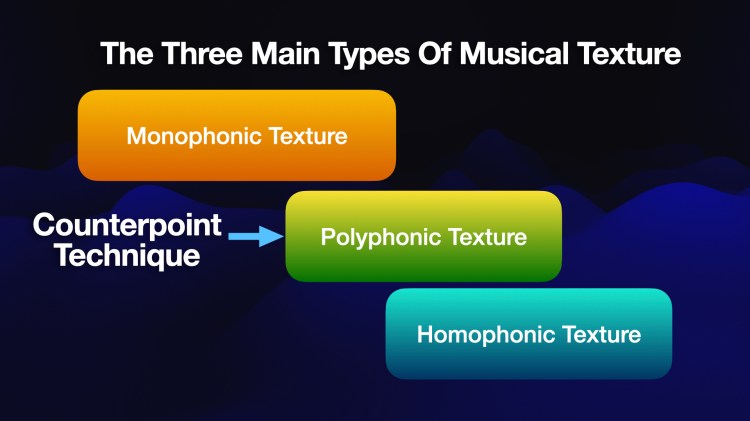


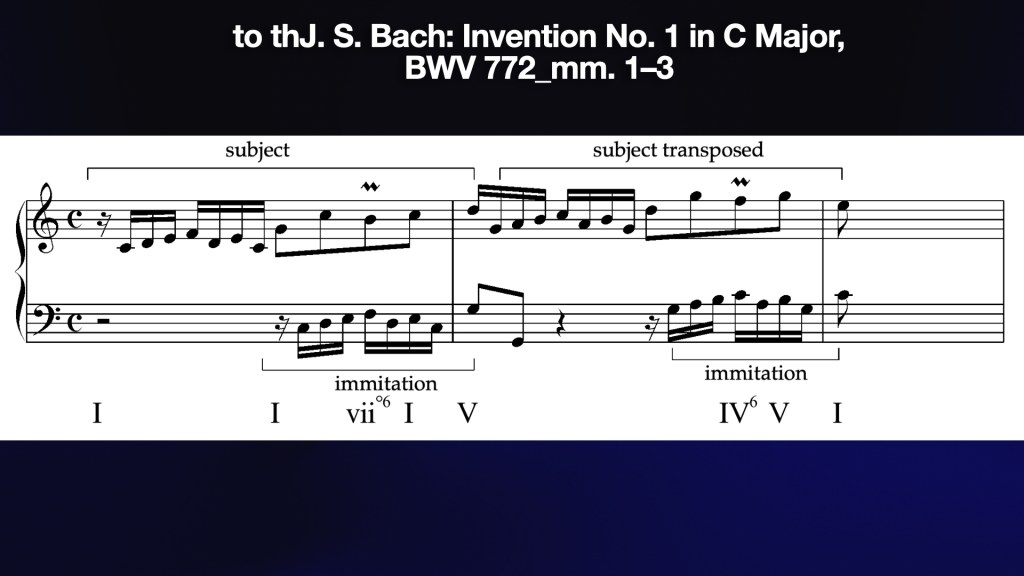
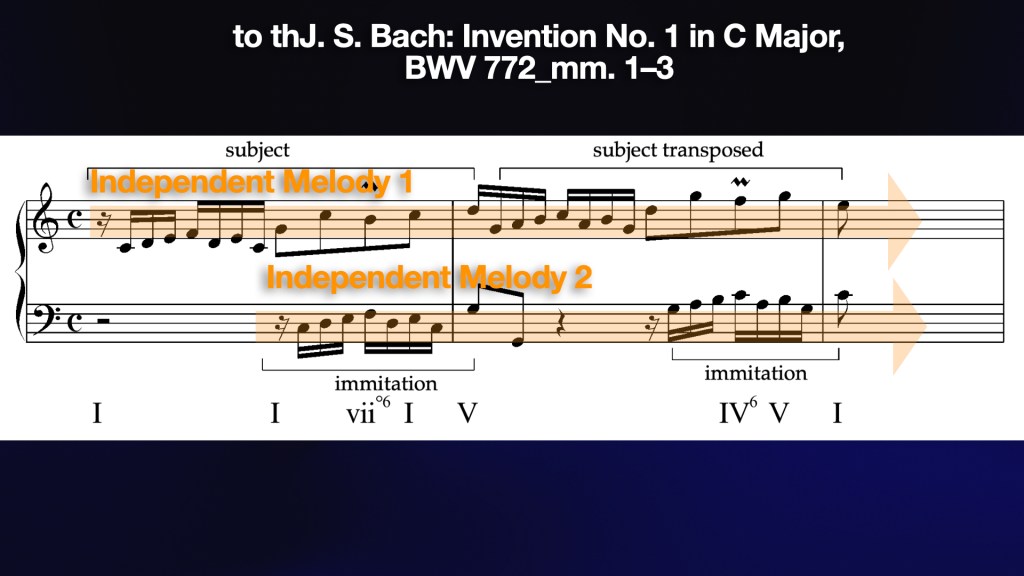

The term derives from the Latin punctus contra punctum—” point against point”—which reflects the interplay of distinct musical ideas. This technique is fundamental in Western art music, requiring a balance between melodic independence and harmonic coherence.
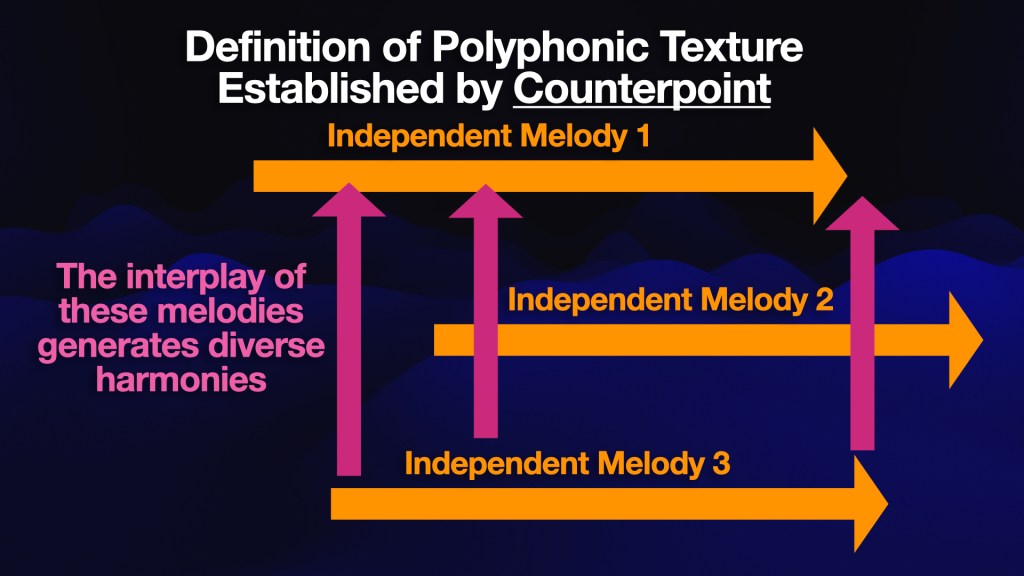
Counterpoint is the art of combining multiple independent musical lines, melodies, or voices, into a cohesive and harmonious texture. Unlike homophonic texture, where chords support a melody, counterpoint treats each voice as an independent melody, interacting harmonically with the others.
In a musical work employing counterpoint techniques, from a horizontal perspective, each voice is treated as an independent melody. From a harmonic perspective, blending these melodies also creates diverse chords.
In other words, in contrapuntal texture, the interplay of melodies generates diverse harmonies, while in homophonic texture, the accompaniment provides the primary harmonic framework.


Counterpoint vs. Polyphonic Texture:
Counterpoint:
Counterpoint is a compositional technique to structure the interaction between independent voices in polyphony.
Polyphonic Texture
= Contrapuntal Texture
= Multiple-Voice Texture:
Polyphonic texture in music results from applying counterpoint techniques.
The three types of musical textures—monophony, polyphony, and homophony—have been integral to music history. This also implies that composers have widely employed counterpoint techniques throughout the ages, as they enable the creation of layered and intricate musical structures. In general, polyphonic texture was predominantly used during the late Medieval, Renaissance, and Baroque periods, while composers of the Classical and Romantic periods tended to favor homophonic texture in their works. However, polyphonic texture remained a vital tool for composers such as W. A. Mozart, J. Brahms, and F. Schubert, who infused their works with tension and emotion.
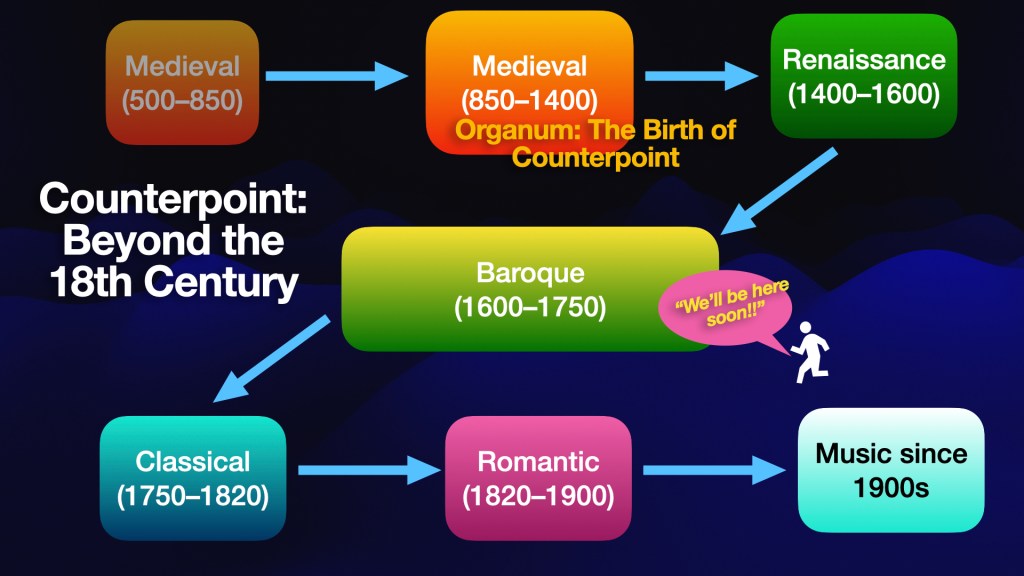

Counterpoint is not confined to a single era but is a cornerstone of musical expression. Its journey through history is both rich and transformative:
Counterpoint Techniques Used in Medieval Period (approx. 850 – 1400): Counterpoint began with organum, where a second melodic line was added to a plainchant, creating early examples of polyphony.
Alleluia: The Angel of the Lord;
Responding (Oblique Organum)
Description:
This piece was performed in the oblique organum style of early polyphony.
Renaissance Period (approx. 1400s – 1600s):
Composers like Josquin des Prez and Palestrina refined the counterpoint, achieving intricate, seamless polyphony emphasizing balance and clarity.
Giovanni Pierluigi da Palestrina:
Ave Maria for Five Voices (SSATB)
(1575)
Description:
Published in 1575 as the second piece in his collection Motettorum liber tertius, this motet showcases Palestrina’s exceptional skill in Renaissance polyphony, highlighted by its smooth interplay of independent melodies and tranquil harmonic structure.
Baroque Period (approx. 1600s – 1750s):
The 18th Century represents the pinnacle of counterpoint, with composers like J.S. Bach crafting monumental works such as The Art of Fugue and Well-Tempered Clavier, showcasing its technical brilliance and expressive depth.
J. S. Bach:
Prelude No. 2 in C Minor, BWV 847
Well-Tempered Clavier, Book I
Classical Period (approx. 1750s – 1820s): While the Classical era simplified textures, counterpoint remained vital in the works of Haydn, Mozart, and Beethoven, who used it to develop and intensify musical ideas.
Ludwig van Beethoven:
Grosse Fuge, for String Quartet, Op. 133
Description:
A mix of different musical textures.
Romantic Period (approx. 1820s – 1900s): Schubert, Schumann, Brahms, and Richard Wagner were still using counterpoint techniques in their works to create layered compositions. These techniques were especially useful when writing music for large orchestras.
Franz Schubert:
Piano Sonata in B Major, D.575
Description:
A mix of different musical textures.
J. Brahms:
Violin Sonata No. 2 in A major, Op. 100
Description:
One-against-one counterpoint
Busoni:
Fantasia Contrappuntistica, BV 256
Description:
One-against-one counterpoint
Music from the 1900s to present: Counterpoint thrives in contemporary classical compositions and even popular music. From complex textures in film scores to contrapuntal techniques in progressive rock and jazz, the principles of counterpoint remain relevant.
Béla Bartók:
Music for Strings, Percussion and Celesta, Sz. 106
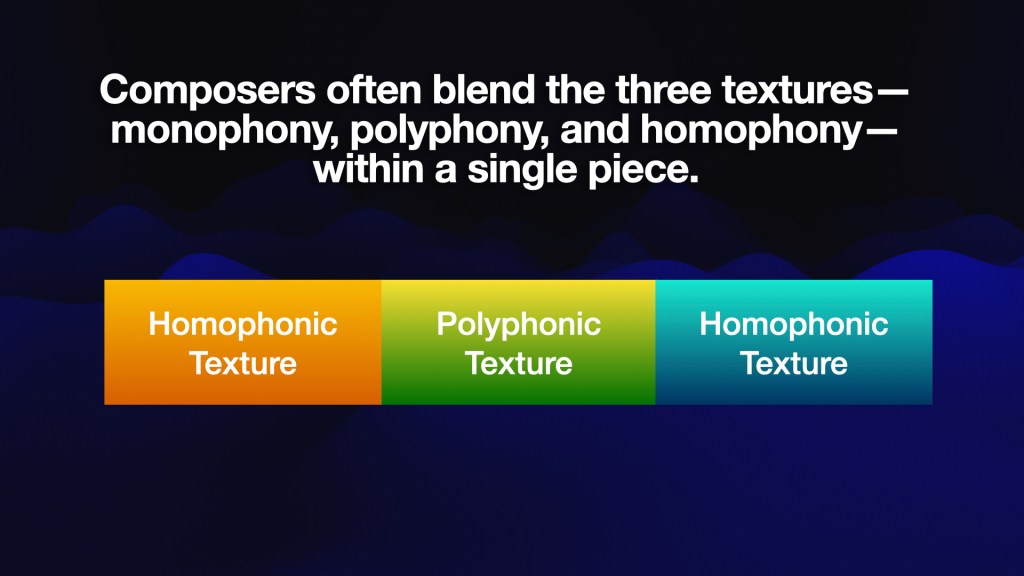
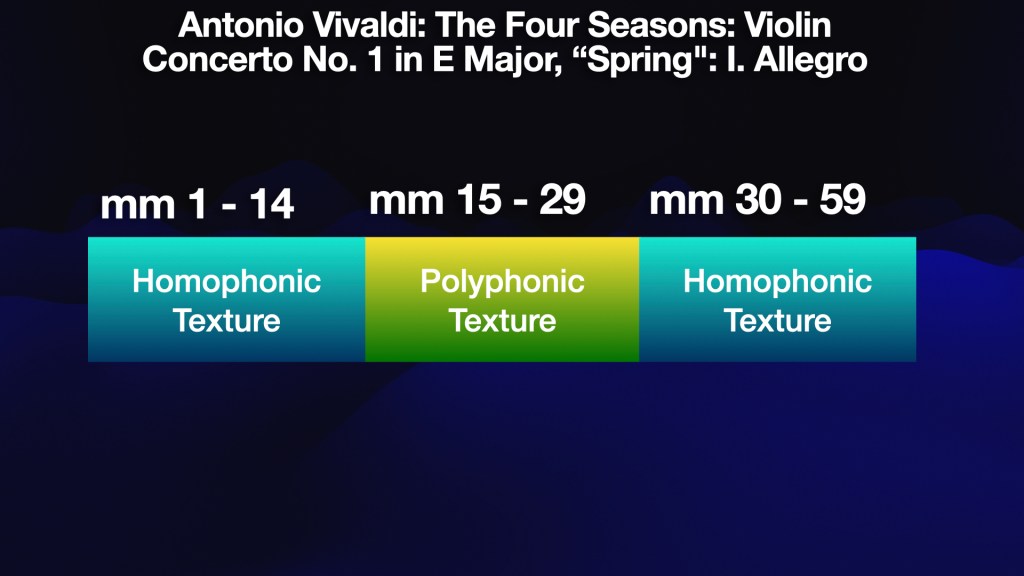
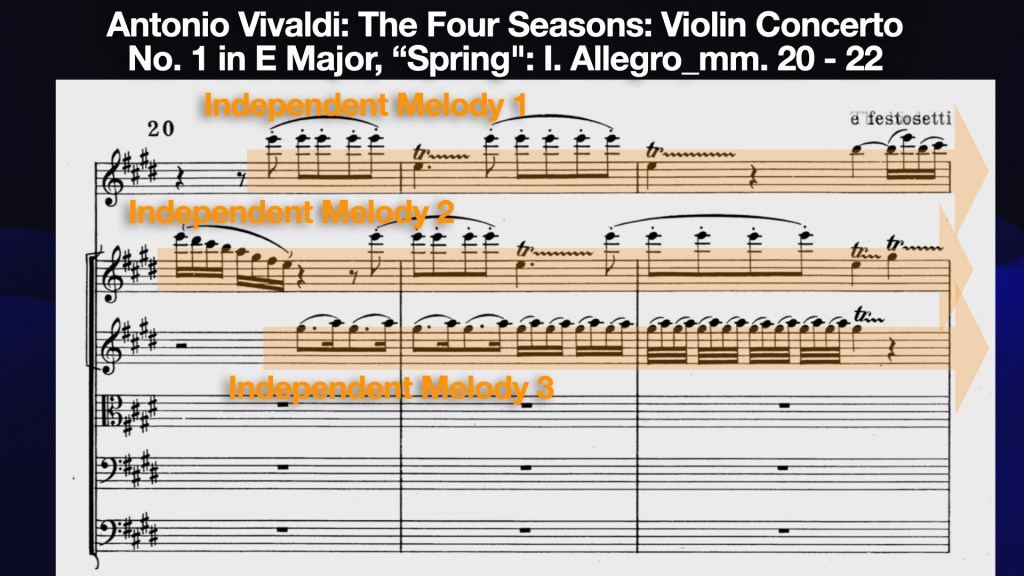
Moreover, composers often blend these three textures within a single piece. For example, Antonio Vivaldi employs a variety of textures in the first movement of his Four Seasons: Spring, a violin concerto.

 Yi-De Chen, Composer